Navigating Thanksgiving in Eating Disorder Recovery: A Practical, Compassionate Guide
November, 2025
“Don’t yuck my yum.”
- Anna, Director of Operations & Nutrition

Thanksgiving can be wonderful. It can also be a lot. If you’re in eating disorder recovery, or you’re supporting someone who is, the day can come with extra layers: food everywhere, routines flipped upside down, and well-meaning relatives asking questions.
If you’re feeling anxious heading in, you’re in good company, and also in good hands. With planning, support, and a few grounded strategies, the day can feel steadier, safer, and far more doable.
Below is a recovery-aligned roadmap for Thanksgiving created by The Lotus Collaborative’s clinical team (with insights from current clients). Think of it as a guide to help you move through the day with more agency, self-trust, and compassion.
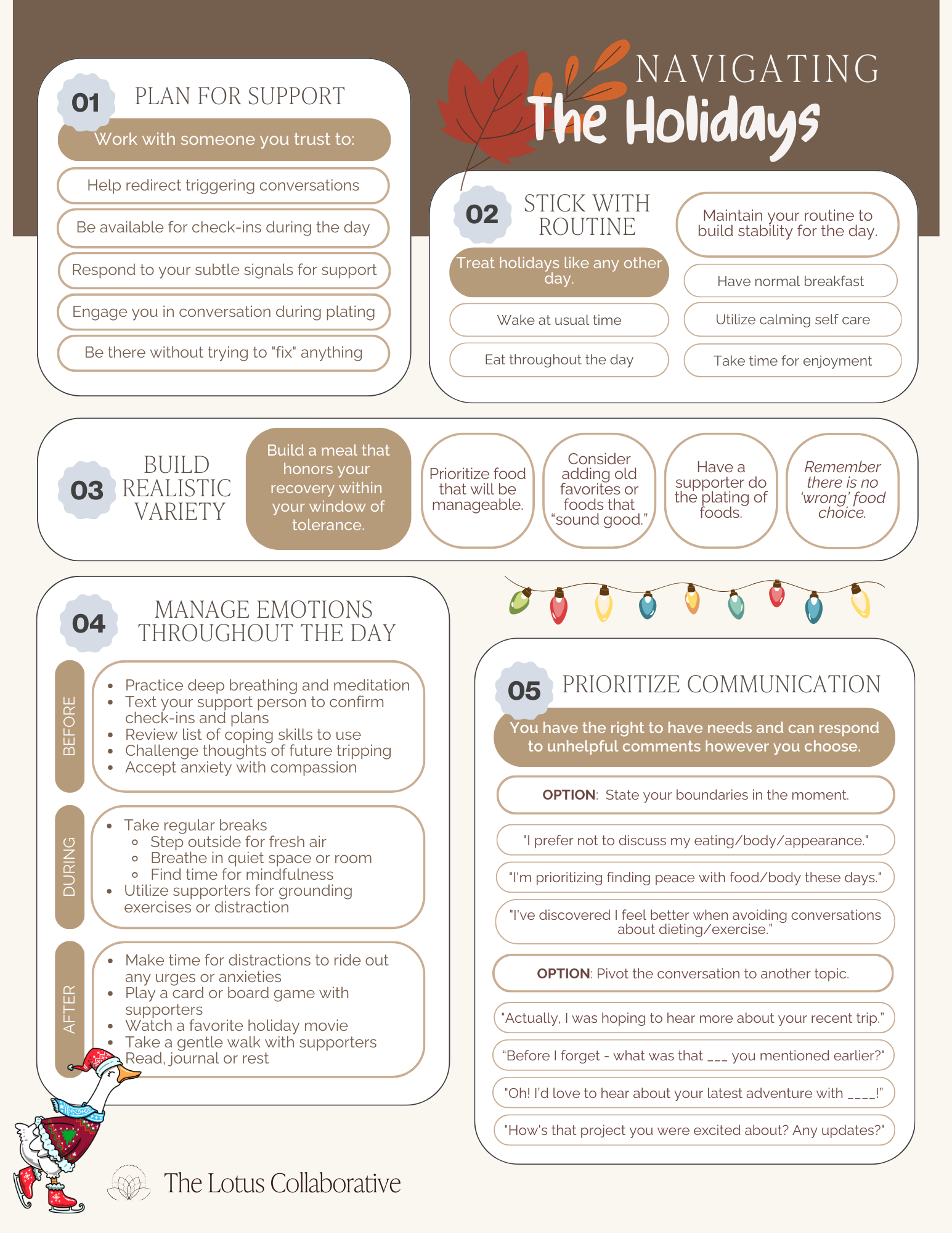
For You
Plan For Support
Recovery doesn’t mean you never struggle. It means you learn how to meet struggle with tools and support.
If you can, make a simple plan with someone you trust. Ask them to:
Help redirect triggering conversations
Be available for check-ins during the day
Respond to your subtle signals for support
Engage you in conversation during plating
Be there without trying to “fix” anything
Stick With Routine
Treat Thanksgiving Day like any other day. Maintain your routine to build stability for the day.
Wake at your usual time
Eat throughout the day
Have your normal breakfast
Utilize calming self-care
Take time for enjoyment
Build Realistic Variety
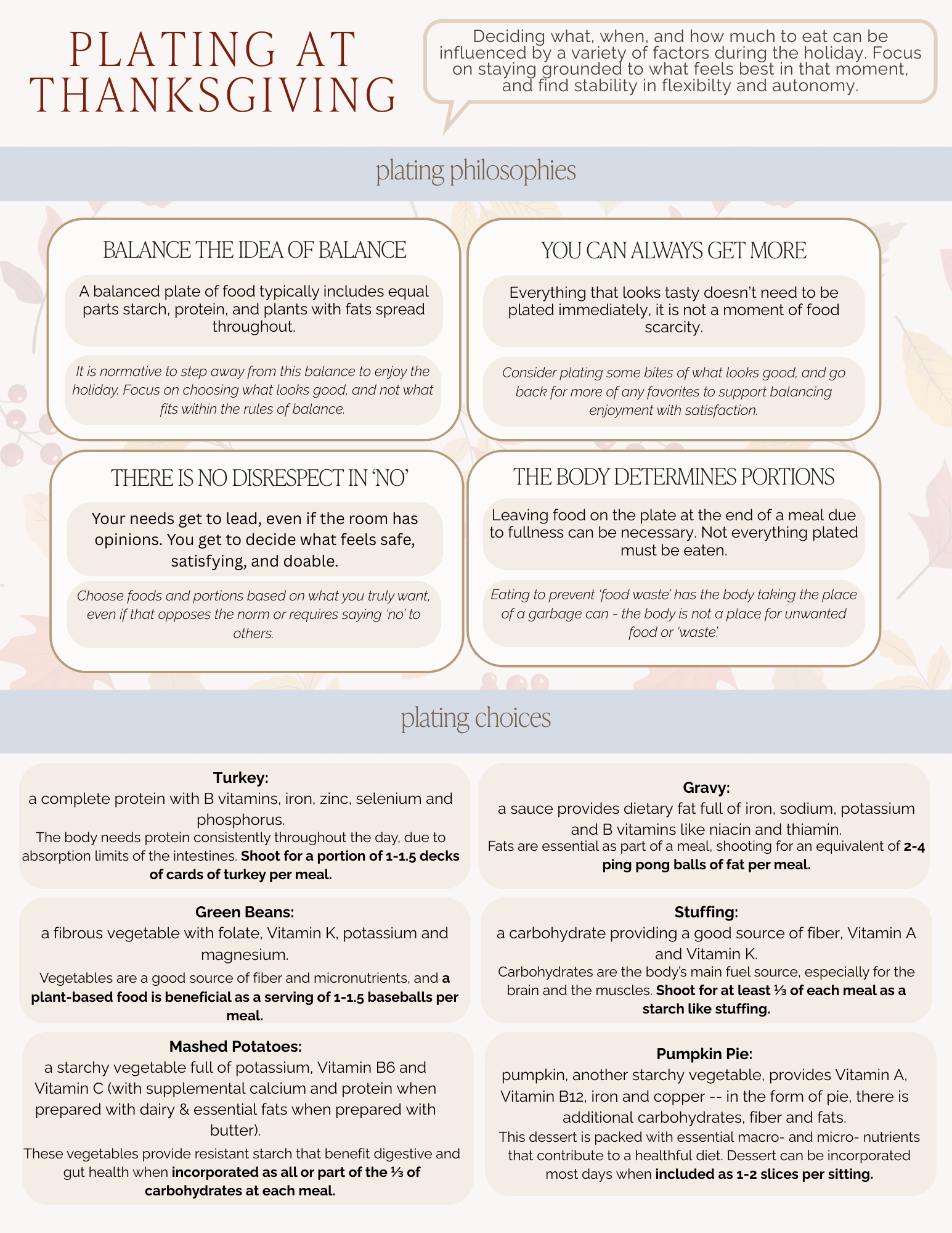
Build a meal that honors your recovery within your window of tolerance.
Prioritize food that will be manageable
Consider adding old favorites or foods that “sound good”
Have a supporter do the plating of foods
Remember there is no ‘wrong’ food choice.
Manage Emotions Throughout The Day
Practice deep breathing and meditation
Text your support person to confirm check-ins and plans
Review list of coping skills to use
Take regular breaks
Watch a favorite holiday movie
Take a gentle walk with supporters
Read, journal or rest
Prioritize Communication
You have the right to have needs and can respond to unhelpful comments however you choose.
Option: State your boundaries in the moment.
“I prefer not to discuss my eating/body/appearance.”
“I’m prioritizing finding peace with food/body these days.”
"I've discovered I feel better when avoiding conversations about dieting/exercise.”
Option: Pivot the conversation to another topic.
“Actually, I was hoping to hear more about your recent trip.”
“Before I forget, what was that _ _ _ you mentioned earlier?”"Oh! I’d love to hear about your latest adventure with ____!”
"How's that project you were excited about? Any updates?"
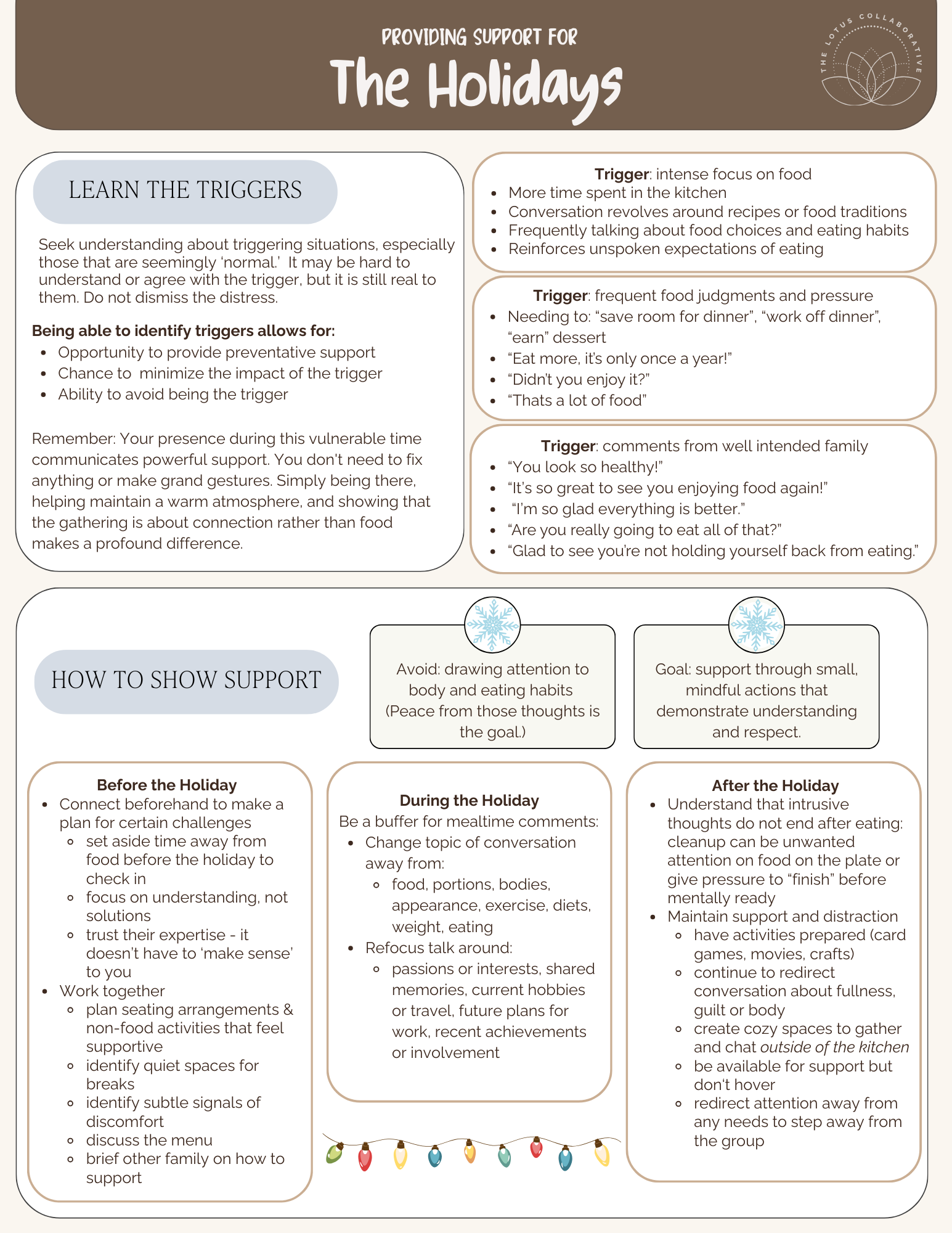
For Supporters
Recovery doesn’t happen in isolation. If you’re a partner, parent, sibling, or friend trying to support someone you love through Thanksgiving, you play a quiet but powerful role. You don’t have to fix anything. What helps most is presence, curiosity, and a willingness to understand experiences that may differ from your own.
Here’s how to show up in a way that communicates steadiness, safety, and genuine care.
Learn the Triggers
Seek understanding about triggering situations, especially those that are seemingly ‘normal.’ It may be hard to understand or agree with the trigger, but it is still real to them. Do not dismiss the distress.
Being able to identify triggers allows for:
opportunity to provide preventative support
chance to minimize the impact of the trigger
ability to avoid being the trigger
Remember: Your presence during this vulnerable time communicates powerful support. You don't need to fix anything or make grand gestures. Simply being there, helping maintain a warm atmosphere, and showing that the gathering is about connection rather than food makes a profound difference.
Before Thanksgiving
Connect beforehand to make a plan for certain challenges
set aside time away from food before the holiday to check in
focus on understanding, not solutions
trust their expertise - it doesn’t have to ‘make sense’ to you
Work together
plan seating arrangements that feel supportive
identify quiet spaces for breaks
plan non-food activities
*identify subtle signals of discomfort
*discuss the menu
*brief other family on how to support
How to Show Support
During Thanksgiving
Be a buffer for mealtime comments
change topic of conversation away from: food, portions, bodies, appearance, exercise, diets, weight, eating
refocus talk around: passions or interests, shared memories, current hobbies or travel, future plans for work, recent achievements or involvement
After Thanksgiving
understand that intrusive thoughts do not end after eating: cleanup can be unwanted attention on what is on the plate or give pressure to “finish” before mentally ready
maintain support and distraction
have activities prepared (card games, movies, crafts)
continue to redirect conversation about fullness, guilt or body
create cozy spaces to gather and chat outside of the kitchen
be available for support but don‘t hover
redirect attention away from any needs to step away from the group
If Thanksgiving Feels Like Too Much
If you’re struggling to imagine getting through the day, it may be a sign you need more support.
At The Lotus Collaborative, we offer:
Eating Disorder IOP and PHP for ages 14+
Mood and Trauma IOP for adults 18+
Free, therapist-led Community Support Group
📞 Call 855-852-4968
📧 Email info@thelotuscollaborative.com
📋 Fill Out a Consultation Request Form📍 Virtually throughout California, In-person in Santa Cruz and San Francisco
Written & Created by Lea Horsley & Anna Riverso
Free Resources (for you & your supporters)
Explore more of our blogs with behind the scenes peeks into our day-to-day programming!